Few people realize the intricate and detailed steps required to produce
an accordion. About 6000 parts are combined in a process involving
hundreds of man hours to bring an accordion to life.
The better factories embark on the construction years before the instrument
is actually fabricated. Fine, precut woods are patiently stored a
minimum of three years, under rigid temperature, humidity and air
current control, to assure the full seasoning cycle before they will
be used to build a future instrument.
An average of 300 square inches of prime suede and kidskin will be
used for each accordion. These leathers must be dated and ideally
stored for additional aging of at least two years before careful selection
is made for use.
Celluloids, specially formulated for accordion fabrication, are ideally
of extra heavy grade with deep color pigmentation to permit the multiple
sanding and buffing required to obtain the rich gloss finish. Celluloid,
too, must have years of aging under ideal conditions to eliminate
the material's tendency towards shrinkage.
The reeds of a quality accordion must be vibrant Swedish blue steel,
hand-fitted, riveted on precision duraluminum plates, and individually
tuned for brilliant voicings. It is a formidable realization to conceive
that the usual accordion with four sets of treble reeds and five sets
of bass reeds has no less that 448 single reed tongues to be painstakingly
tuned by a craftsman who specializes in the time honored skill.
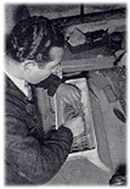
In these pictures and captions, Accord conducts you on a guided tour
through an accordion factory in Italy. Not all phases of accordion
production are pictured, but enough are shown to give the reader an
idea of how an accordion makes its way into the world of music.
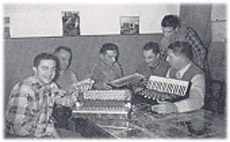 Engineering
and design problems take endless hours as the instrument's evolution
results in advancements. Here, in an informal European atmosphere,
countless years of experience in accordion construction are pooled
to arrive at solutions which will enhance the accordion's position
in the music world.
Engineering
and design problems take endless hours as the instrument's evolution
results in advancements. Here, in an informal European atmosphere,
countless years of experience in accordion construction are pooled
to arrive at solutions which will enhance the accordion's position
in the music world.
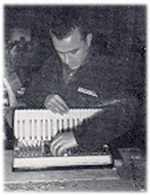
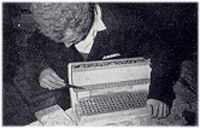
 These
are various stages in the assembly of the accordions' treble keyboards
- similar in either piano key or button style. The treble plates must
be carefully channeled for trouble free operation. Great skill is
required to assemble a first-class keyboard mechanism and even more
care must be taken if the treble includes tone chamber construction.
These
are various stages in the assembly of the accordions' treble keyboards
- similar in either piano key or button style. The treble plates must
be carefully channeled for trouble free operation. Great skill is
required to assemble a first-class keyboard mechanism and even more
care must be taken if the treble includes tone chamber construction.
Skilful
craftsmanship and carefully chosen materials are vital components
of a fine quality accordion. No short cuts are possible when producing
instruments which are truly responsive and capable of the most magnificent
musical range and colorations.
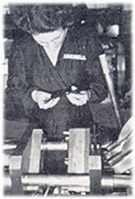 Injection
molding produces the black keys for sharps and flats. Precision dies
are used to make a variety of functional and ornamental components
of the accordion.
Injection
molding produces the black keys for sharps and flats. Precision dies
are used to make a variety of functional and ornamental components
of the accordion.
Great effort is required to 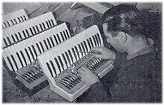 make
the treble registers respond instantly by activation the slides which
open and close appropriate tone holes, permitting the desired reed
combinations to sound. Here, the molded levers are fitted to the treble
switch assembly on the grille and the inner mechanism of the treble
registers is adjusted for smooth operation.
make
the treble registers respond instantly by activation the slides which
open and close appropriate tone holes, permitting the desired reed
combinations to sound. Here, the molded levers are fitted to the treble
switch assembly on the grille and the inner mechanism of the treble
registers is adjusted for smooth operation.
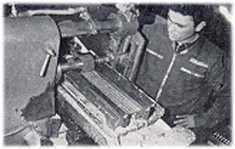
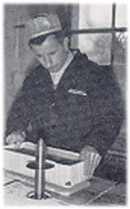 The
The
 Many
stages of bass case construction require much careful work, such as
this painstaking shaping on a circular spindle cutting machine, the
final woodwork detailing, and trimming the smoothly-contoured plastic
covering.
Many
stages of bass case construction require much careful work, such as
this painstaking shaping on a circular spindle cutting machine, the
final woodwork detailing, and trimming the smoothly-contoured plastic
covering.
Few musicians can rise above the limits imposed by their instrument.
A fine accordion will unleash creativity through its increased musical
capacity and potentially expanded musical scope.
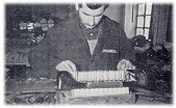 The
sea of bass buttons, which confounds the novice, is no mystery to
these craftsmen who carefully assemble the intricate bass machine
mechanism. Rods and pistons, brass pins and mechanical-noise insulators
are individually positioned to create the wonderous bass machine,
some of which provide innovations such as convertor or chromatic free
bass and pedal tones in addition to the stradella system.
The
sea of bass buttons, which confounds the novice, is no mystery to
these craftsmen who carefully assemble the intricate bass machine
mechanism. Rods and pistons, brass pins and mechanical-noise insulators
are individually positioned to create the wonderous bass machine,
some of which provide innovations such as convertor or chromatic free
bass and pedal tones in addition to the stradella system.
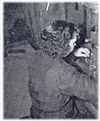 The
various reed operations are numerous, beginning with a huge
The
various reed operations are numerous, beginning with a huge 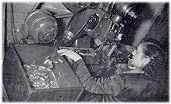 power
press which die-stamps the plates, the making of the multi-chambered
reed blocks, the precise die-cutting of the reed tongues, selection
provino-tuned reeds and carefully waxing them onto the blocks to assure
air-tight fit.
power
press which die-stamps the plates, the making of the multi-chambered
reed blocks, the precise die-cutting of the reed tongues, selection
provino-tuned reeds and carefully waxing them onto the blocks to assure
air-tight fit.
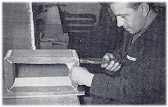 The
bellows, which enable the instrument to offer an amazing range of
expression, are constructed of special cardboards, lined with fabric
and leather "diamonds" which are positioned in the corners of each
fold. All outer sides have folds tape-reinforced, bonded with specially
formulated hot glue and finished with precision pinched chrome corners.
Here, electroplating the bellows' corners in a chrome bath and pinching
them into positions shown.
The
bellows, which enable the instrument to offer an amazing range of
expression, are constructed of special cardboards, lined with fabric
and leather "diamonds" which are positioned in the corners of each
fold. All outer sides have folds tape-reinforced, bonded with specially
formulated hot glue and finished with precision pinched chrome corners.
Here, electroplating the bellows' corners in a chrome bath and pinching
them into positions shown.
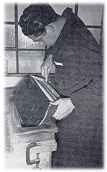 After
the treble and bass selections have been assembled, the reeds in each
are tuned by a craftsman. Following this, the instrument will be fully
assembled and both sides will be tuned to each other to complete the
process.
After
the treble and bass selections have been assembled, the reeds in each
are tuned by a craftsman. Following this, the instrument will be fully
assembled and both sides will be tuned to each other to complete the
process.
When purchasing an accordion there are many points to consider.
The instrument represents a sizeable investment which warrants careful
study.
Some important considerations are enumerated below. Most of them are
equally significant whether the accordion is brand-new or an older,
second-hand instrument.
Keyboard and Action
Fast action is important; released keys must close firmly,
their pads must cover without leakage and be fastened securely. Avoid
keys which bind, stick, or are warped - keyboard must be level, not
too high, have uniform action, and no mechanical noise.
Basses and Action
Basses must be responsive; buttons should come up quickly
and firmly. Chord buttons must produce complete, accurate chords.
Mechanical noise must be eliminated.
Reeds and Reed Blocks
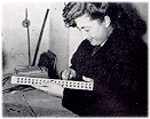 The
accordion must be able to play a sustained note very loud or very
soft and respond instantly to the slightest bellows movement. Response
of all reeds should be balanced on a chord. Blocks must be seated
perfectly to avoid air loss or waste, They should have multiple coats
of high-lustre varnish to enhance tone and protect against warpage.
The
accordion must be able to play a sustained note very loud or very
soft and respond instantly to the slightest bellows movement. Response
of all reeds should be balanced on a chord. Blocks must be seated
perfectly to avoid air loss or waste, They should have multiple coats
of high-lustre varnish to enhance tone and protect against warpage.
Tuning
Check for accuracy to be sure the accordion is in tune with
other instruments as well as itself - both hands and in all reed lines.
Bellows, Gaskets and Pads
If these are poorly attached, badly made or mal-fitting, the
instrument will "leak" and require extra hard pumping instead of the
normal easy pressure required to play a sustained note.
Registers and Plates
When plates are warped or badly fitted, registers cannot work
smoothly and air loss may result. Examine for excess "play" and be
sure registers and slides close ports fully.
Instrument Service
Legitimate dealers provide service facilities. The best source
for student instruments is a dealer who offers a planned program of
music education with good lessons, expert service and future aids.
Maximum advantages are available from a reputable dealer who is able
and willing to serve customers' musical needs.
Factory Name Brands
Avoid "fake" brand names. Trace the name to be sure that a
real manufacturer and a known factory of good reputation actually
stand behind the instrument. Brands which are the name of the importer
usually are not produced in a reputable factory and therefore cannot
offer consistent quality.