"Many people
who love music never thought of attending an accordion concert, but
go regularly to chamber music series," observes Frank Hohner of M.
Hohner, Inc. Thus, an entirely new accordion concept is being fostered
on concert-goers as the instrument finds its place in ensembles. Educator
Robert Davine, himself
a concert performer, surveys this role.
 Chamber
music may be defined as instrumental ensemble music performed by one
player to a part, as opposed to orchestral music, in which there are
several players to a part. Emphasis lies on the ensemble rather than
the single player. Instrumental ensemble pieces already existed in
the late Middle Ages by composers such as Obrecht, Isaac, Hofhaimer,
and in the 16th century by composers such as Willaert, Buus, and Padovano.
Musicians to this day have continued to value chamber music, primarily
because it permits a refinement and intimacy of expression that cannot
be derived from a large musical organization.
Chamber
music may be defined as instrumental ensemble music performed by one
player to a part, as opposed to orchestral music, in which there are
several players to a part. Emphasis lies on the ensemble rather than
the single player. Instrumental ensemble pieces already existed in
the late Middle Ages by composers such as Obrecht, Isaac, Hofhaimer,
and in the 16th century by composers such as Willaert, Buus, and Padovano.
Musicians to this day have continued to value chamber music, primarily
because it permits a refinement and intimacy of expression that cannot
be derived from a large musical organization.
Since the accordion has so many attributes that are conducive to chamber
music, it is particularly suitable for this medium of expression.
In essence, the accordion has all of the prerequisites essential to
small ensemble involvement: sustaining power, dynamic sensitivity,
articulated response, timbre and texture variance, and compatibility
of sound with string and wind instruments.
During the Baroque period (1600-1750), chamber music with some type
of keyboard instrument (small organ, harpsichord) became prevalent
with trio sonatas. This kind of chamber music is written in three
parts with similar range and design and a supporting figured-bass
part. The trio sonata is usually performed on four instruments: two
violins for the upper parts, a cello for the bass part, and a keyboard
instrument for the bass part with the realization of the thorough
bass (harmony) accompaniment.
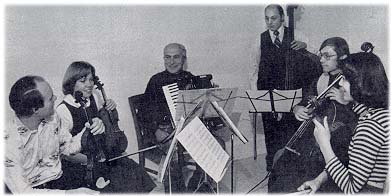 The
accordion, in the role of the keyboard part, maintains the clarity
of sustained lines that are essential to the character of this kind
of music. Playing the keyboard part on the accordion requires little
or no modification - especially if performed on an instrument, which
has the extended potential of a free bass system. Since the trio sonata
was the most important type of Baroque chamber music, almost all composers
of this period wrote for this medium. My performing experience has
included the Trio Sonatas by Bach, Handel, Telemann, Corelli and Arne.
The
accordion, in the role of the keyboard part, maintains the clarity
of sustained lines that are essential to the character of this kind
of music. Playing the keyboard part on the accordion requires little
or no modification - especially if performed on an instrument, which
has the extended potential of a free bass system. Since the trio sonata
was the most important type of Baroque chamber music, almost all composers
of this period wrote for this medium. My performing experience has
included the Trio Sonatas by Bach, Handel, Telemann, Corelli and Arne.
In the past 25 years, composers have utilized the accordion in a chamber
setting with particular emphasis on its explosive dynamic power coupled
with transparent sustained qualities. Examples of this kind of writing
are found in Carmelo Pino's Concertino for strings and accordion,
Night Music for string quartet and accordion by David Diamond, Movements
for accordion and string quartet and Duell for accordion and percussion
by Torbjorn Lundquist, Mosaic for flute and accordion by Normand Lockwood,
Trio for guitar, violin and accordion by Jindrich Feld, Introduction
and Allegro by Mathyas Seiber for cello and accordion and Trio for
accordion, piano and cello by Ted Zarlengo.
For the serious accordionist, it is difficult to conceive of a more
challenging and satisfying musical effort than the involvement in
chamber music. Working with other instruments gives one a completely
new perspective about the accordion's unlimited musical resources
and sound control, as well as musical understanding of how one's own
part contributes to the overall shape of the composition. The accordion's
function as the sound producer and controller within the ensemble
must be thoroughly understood to be used most efficiently as the medium
of expression, since music, by its very nature, is a living, breathing
art.
Among the benefits to be derived by utilizing the accordion in a chamber
music setting is not only the musical content gained by the performer,
but the fact that it also stimulates further special interest for
other musicians. The use of the accordion in chamber music, for the
most part, has remained obscure; its importance as an ensemble instrument
has sometimes been misunderstood and many musicians, whose contact
with this instrument has been limited, are unaware of its scope. To
introduce the accordion to musicians and scholars, thereby removing
the misconceptions about its quality and appeal, two things are necessary:
musical understanding and sensitivity to and about playing a part,
which while independent, should be amalgamated within the sound balance
of the whole ensemble.
Obviously, there is no one formula of requirements to become a fine
chamber player, simply because music is such a personal experience
- a quality to be much esteemed in our mass production age - that
each player and listener draws a different benefit from it. For the
accordionist, a completely new and untapped medium of expression is
to be uncovered through the performance of chamber ensemble playing.
The challenge is even more exciting because this medium as not yet
been fully explored.