|
 A
series recalling the leaders of yesterday's popular music. A
series recalling the leaders of yesterday's popular music.
The early-1930s saw the introduction of the cinema organ into dozens
of newly-built auditoriums all over the country. It quickly became a
firm favourite with a public which "went to the flicks" at least once
a week, and when a relatively new instrument suddenly gave them an opportunity
to experience similar sounds in the dance hall, a new style of music
emerged. It soon took over in popularity from the ukulele and its versatility
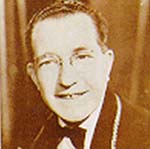
was instantly recognised by one man in particular. Fronting several
different groups, including his own conventional dance band, Harry Bidgood,
alias Don Porto, Rossini and, above all, Primo Scala (pictured right),
became the biggest name among…
House lights dimmed, the
audience hushed, and a growing air of expectancy spread all around.
Suddenly, a crescendo of sound filtered into the auditorium and a spotlight
settled on the orchestra pit. Then, as if by magic, a beaming organist
rose majestically and effortlessly into view, thrilling everyone with
the all-conquering and powerful sound of the mighty Wurlitzer. Invariably
there was a round of applause as the soloist launched forth into his
signature tune.
The time was anything between 40 and 65 years ago, and the organist
could have been Sidney Torch, Reginald Dixon, Sandy MacPherson, Reginald
Foort, Robin Richmond, or a whole host of other famous names. Everyone
loved the sound of the cinema organ but only a privileged few ever got
to play one. The next best thing, however, was a musical instrument,
which caught on in the 1930s, and quickly took over in popularity from
the ukulele. It was the piano-accordion and it came in many sizes, allowing
everyone with a musical touch to enjoy a personal taste of an organ
in miniature. It soon became all the rage and many towns in England
vied with each other to produce the best local accordion bands.
By 1933, the "squeeze-box", as it was affectionately known, was making
an indelible mark on the dance band scene. With three accordions (sometimes
many more), replacing the front-line melody-making instruments, and
backed by the usual rhythm section, the overall sound was often as good,
if not better than many conventional bands. The new genre was not without
its critics, however, and as one wag remarked: "A gentleman is someone
who knows how to play the accordion-but doesn't!"
 A
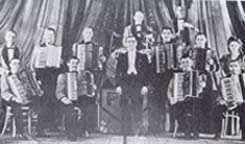
number of different names, began to surface on major record labels,
but were not always what they seemed. The first was " Don Porto and
His Novelty Accordions" who appeared on the 8" Eclipse records sold
at Woolworths for sixpence. When these were phased out in favour of
the 9" Crown label, a new name emerged-"Rossini's Accordions"-but clearly
not formed by the famous classical composer who died in 1868. A
number of different names, began to surface on major record labels,
but were not always what they seemed. The first was " Don Porto and
His Novelty Accordions" who appeared on the 8" Eclipse records sold
at Woolworths for sixpence. When these were phased out in favour of
the 9" Crown label, a new name emerged-"Rossini's Accordions"-but clearly
not formed by the famous classical composer who died in 1868.
Even more up-market was the 10" Rex label which retailed at the princely
sum of one shilling, on which the latin-sounding "Primo Scala and His
Accordion Band" were the star turn. With such famous vocalists as Vera
Lynn, Cavan O'Malley, Sam Costa and Donald Peers, the accordion had
arrived.
However, most of the public never realised that all three bands were
one and the same! All were directed by Harry Bidgood, a Londoner born
in 1898. After starting his musical career as a pianist with the famous
De Groot orchestra at the Piccadilly Hotel, he became the recording
manager for Vocalion before transferring allegiance in 1932 to a rival
firm, Crystalate. Between 1925 and 1937 Harry Bidgood made hundreds
of records with his conventional dance band-also using a variety of
different names-and made several hundred more with his accordion bands
between 1933 and 1944 -- a truly prolific output in a relatively short
space of time.
When Don Proto and Rossini disappeared from the recording studio, Bidgood's
best-known pseudonym took over and lasted into the early 1950s. "Primo
Scala" was a cleverly constructed hybrid, contrived from the forename
of Italy's heavyweight boxing champion, Primo Carnera, together with
the surname of a man who won the famous Irish Sweepstake, Signor Emilio
Scala. It was an exotic-sounding title which perfectly complemented
the atmosphere of an accordion band, and to which the public took a
shine. Everyone agreed that the bread-and -butter name Harry Bidgood
somehow did not have the same ring about it. Indeed, when he died in
1957, Harry was better remembered for his Italian nom-de-plume than
his true English name!
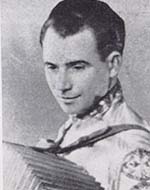 There
were many other accordion groups playing at the same time, but the only
one which seriously rivaled Primo Scala, was the London Piano-Accordion
Band, led at different times by Billy Reid, George Scott-Wood, and Eric
Winstone. Billy Reid's band invariably teamed up with youthful vocalist
Dorothy Squires, who went on to become and international star in her
own right. Billy, meanwhile, left to concentrate his attentions more
on music publishing and composing. There
were many other accordion groups playing at the same time, but the only
one which seriously rivaled Primo Scala, was the London Piano-Accordion
Band, led at different times by Billy Reid, George Scott-Wood, and Eric
Winstone. Billy Reid's band invariably teamed up with youthful vocalist
Dorothy Squires, who went on to become and international star in her
own right. Billy, meanwhile, left to concentrate his attentions more
on music publishing and composing.
Multi-talented George Scott-Wood, born in Glasgow in 1903, recorded
for the Regal Zonophone label and made several tracks between 1934 and
1940, many with Sam Browne as vocalist, during which time he also busied
himself with his own jazz group called the Six Swingers. He also found
time to perform with several other groups. Despite his heavy work load,
and just like Harry Bidgood, he managed to maintain a high standard
of music which the public thoroughly enjoyed-bouncy, catchy, melodic
and tuneful-everything which the modern successor to the old concertina
was capable of achieving via its bellows and keyboard. George Scottwood
died in 1978.
During the war, Eric Winstone (1915-74), was extremely popular as a
solo accordionist and also with his swing quartet, where his virtuoso
playing was well supported by a string bass, guitar and vibraphone.
He later recorded for Regal with the bigger London Piano Accordion Band,
before finally switching to his larger-than-life dance orchestra which
enjoyed several post-war hits. He retained his smaller accordion ensemble
for radio broadcasts, however, especially the ever-popular favourite
program, "Music While You Work". His main vocalists were Alan Kane and
Julie Dawn.
Although the piano-accordion was actually invented in the 19th century
(no less a composer then Tchaikovsky used it in his Suite No.2), its
rise to popularity in the 20th century was caused almost entirely by
its sudden availability to a mass market. Most 1930s music magazines
contained dozens of adverts for the instrument, usually encouraging
payment by installment, or the "never never" as it was cynically termed
in those days. There was even a magazine called The Accordion Times,
which enjoyed a healthy life span before succumbing to new musical trends
and fashions.
The most famous brand name was Hohner, which advertised widely and sold
thousands of instruments. The company also organised an annual accordion
rally at the Central Hall, Westminster, where on one notable occasion
no fewer than 40,000 devotees crammed themselves into a space, which
would today horrify anyone involved with health and safety. There were
no reports of mass riots, however, and everyone clearly enjoyed themselves.
Versatility and volume of sound made the accordion an ideal instrument
for both indoor and outdoor concerts, and many famous singers, both
sacred and secular, used it to accompany themselves. When placed in
a group, however, the options were vast, and accordion bands were extremely
popular for all types of dancing.
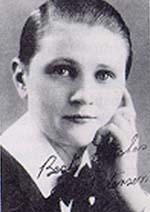 Although
the instrument is still widely used, its heyday has long gone, replaced
firstly by the electric guitar, and more recently by synthesisers and
electronic and computer gadgetry. Its bigger brother, the cinema organ,
has fared much worse and was in grave danger of extinction until a number
of enthusiasts dismantled, removed and have since restored, several
examples of this magnificent "King of Instruments" from a bygone era. Although
the instrument is still widely used, its heyday has long gone, replaced
firstly by the electric guitar, and more recently by synthesisers and
electronic and computer gadgetry. Its bigger brother, the cinema organ,
has fared much worse and was in grave danger of extinction until a number
of enthusiasts dismantled, removed and have since restored, several
examples of this magnificent "King of Instruments" from a bygone era.
Novelties they may have seemed, but the best accordion groups were genuine
dance bands, capturing the spirit of an age when tastes were simple.
Pleasures uncomplicated, and enjoyment easily fulfilled. They provided
extra dimensions of sound in a single and highly mobile instrument,
sounds perhaps equaled by the piano, but surpassed only by the enormous
but very static cinema organ. Small wonder that piano-accordions were
so popular.
|