Polling its eight
million readers, Better Homes magazine recently invited (article published
in 1979) them to share their feeling about the quality of life today
through a questionnaire titled "Do you feel family life in America
is in trouble?" A resounding "Yes" was the answer from a whopping
76% of the respondents.
Quite apparent is the deep concern expressed about behavioral trends
and their adverse effect on people's relationships. Attempting to identify
causes for the decline in community well-being, the readers mention
many sides of the problem:
1. Nearly 40% said inattentive parents are the greatest threat
to family life. ("Parents don't want to be bothered anymore.")
2. 21% blamed materialism. ("Necessities are confused with luxuries.")
3. The "Me first" attitude. ("'Doing your own thing' was condemned
as irresponsible and selfish.")
4. A wide-spread malaise and purposelessness. ("We lack worthwhile
goals to motivate and inspire.")
The report states that "too much permissiveness leaves a child so confused
and undisciplined in an orderly society. Too much strictness can inhibit
him so that creativity is stifled and he is afraid to show initiative,
thereby limiting his potentiality as a contributing member of the community."
Faced with all this confusion, "parents' values appear to be in turmoil,
so they're having a hard time advising their kids." People are groping
for help in setting limits, inspiring goals and constructively employing
the energies and resources of their children.
This common search for the good environment, higher standards, creative
opportunities, realistic restrictions and inspirational goals is undoubtedly
the most potent force which leads concerned parents to the door of the
music studio in their community. Here their child encounters the perfect
medium to mold character and personality while developing habits and
attitudes of lifelong value. Hidden within the enjoyable experience
of music are unlimited opportunities to improve a child's capacity for
thinking, his ability to concentrate and his attention span, while encouraging
greater independence and resourcefulness.
Almost every child has native ability for music and music can help greatly
during those emotional stresses experienced by most children, especially
in the formative adolescent years. What other activity can match music
in relieving nervous tension by substituting a sense of accomplishment
for feeling of frustration and anger?
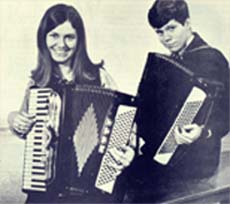 The
piano accordion, one of the three basic keyboard instruments, is the
most effective tool to enable a child to derive the greatest benefits
in personality, character and educational development. Psychologists
and educators cite music for its unique influence on people because
it both thrills and calms, stimulates and refreshes. Group participation,
for which the accordion is particularly suited, teaches further valuable
lessons in teamwork, acceptance of leadership and responsibility to
others. The
piano accordion, one of the three basic keyboard instruments, is the
most effective tool to enable a child to derive the greatest benefits
in personality, character and educational development. Psychologists
and educators cite music for its unique influence on people because
it both thrills and calms, stimulates and refreshes. Group participation,
for which the accordion is particularly suited, teaches further valuable
lessons in teamwork, acceptance of leadership and responsibility to
others.
Perhaps the greatest advantage the piano accordion offers is that it
is designed to entertain as well as instruct the young child. He learns
to play simple tunes in the first lesson and he obtains definite satisfaction
from his continuing step-by-step progress. Effort is immediately followed
by rewarding accomplishment, the instantaneous gratification which a
child requires to encourage a pattern of ever-increasing amounts of
effort and mental discipline.
At the very first lesson, the beginner learns that by pressing one button
he can play a whole chord. Not only are the chords produced mechanically,
but so is the pitch, making it easy for youngsters to get pleasing results.
Moreover, he is immediately ready for the satisfying involvement of
group activity through band participation with other youngsters at his
own level.
The piano accordion can be played as a solo instrument, as part of a
musical group, or to accompany singing. It is one of the few instruments
that teaches melody, harmony, and rhythm all at the same time, providing
effective groundwork in music structure and harmony.
Perhaps the most versatile of musical instruments, the accordion is
lightweight and portable, and readily fits into musical enjoyment at
outdoor parties or wherever people get together to have good, wholesome
fun.
At a time when wholesome occupation for young people is a prime concern
to parents who care about their children's character development, the
accordion has distinguished itself as an unique tool, used in music
programs to develop personality, self-confidence, coordination, mental
discipline and a sense of responsibility in an environment which is
creative, stimulating and satisfying.
 In
recognizing the accordion's strong, natural appeal to children, there
are five prime reasons for its ever growing popularity as an effective
vehicle for educational and personal enrichment. In
recognizing the accordion's strong, natural appeal to children, there
are five prime reasons for its ever growing popularity as an effective
vehicle for educational and personal enrichment.
First, children value a sense of achievement - the feeling
that they are "getting somewhere", and accomplishing something
worthwhile. The accordion meets this condition well because the beginner
soon finds himself able to make real music and, as he progresses, is
rewarded by a conciousness of growing mastery.
Second, children thrive on challenges that are somewhat
difficult. The accordion offers just the right degree of difficulty.
Some measures of success can come soon, inspiring greater effort. Serious
work is required, but this work is rewarded by a particularly intimate
satisfaction, providing an excellent opportunity for parental approval
and praise.
Third, children and young people have powerful social
tendencies. They enjoy being noticed and admired taking the lead, and
getting on well with companions. The accordion enables them to satisfy
these normal and natural desires for attention in a constructive way.
Fourth, children, as well as adults, like to feel that
what they are doing and learning has genuine significance. The accordion
leads them, by easy steps, into the exciting world of musical art. Though
easy to play, it is a serious instrument that will present new musical
horizons and challenge personal creativity.
Fifth, children need group activity to hold interest.
It is boring to limit music to sitting by oneself and practicing. Because
the accordion is oriented to group activities (there are thousands of
accordion ensembles, bands and orchestras), it will sustain long-term
interest, providing opportunities to develop a sense of responsibility
and coordinated effort.
Boys and girls everywhere enjoy making music with this versatile instrument.
Accordion playing youngsters come from every walk of life, but they
have in common, as a rule, parents with a keen interest in their environmental
exposures and a strong desire to maximize the benefits to be found within
the natural abilities of their children.
It is today widely recognized that schools alone cannot take responsibility
for a child's total development. In order for education to be effective,
a teacher must teach well and a child must learn well. The family is
responsible for the child's ability to learn and it is the family which
must provide the environmental stimulus to develop the natural abilities
with which children are endowed, so that they may grow to be valuable
adult members of the community.
The music studio, particularly the accordion studio, plays and important
role in helping  parents
meet these responsibilities. The dedicated teacher has formulated his
music program to answer the needs of young people, using the accordion
as an effective vehicle to cultivate habits and attitudes of lifetime
benefit. In helping young people to establish patterns for success,
the teacher touches the future and makes a significant contribution
to the quality of life tomorrow. parents
meet these responsibilities. The dedicated teacher has formulated his
music program to answer the needs of young people, using the accordion
as an effective vehicle to cultivate habits and attitudes of lifetime
benefit. In helping young people to establish patterns for success,
the teacher touches the future and makes a significant contribution
to the quality of life tomorrow.
|